Least Concern
Murray River Turtle
Emydura macquarii
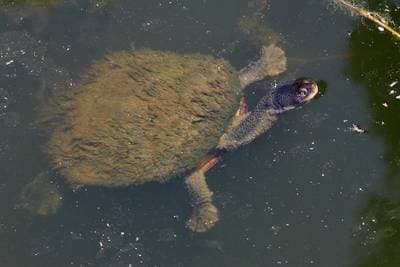
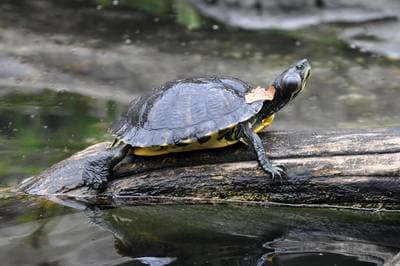
The Murray River turtle is one of Australia's most recognizable freshwater turtles, inhabiting rivers along Australia's eastern coast, particularly within the Murray-Darling river system that gives the species its name. With its smooth, elongated shell in shades of brown or olive-green and the remarkable ability to breathe underwater through its cloaca, this turtle is perfectly adapted for life in slow-moving rivers and lakes.
John Robert McPherson (CC0)
Learn together
Use this page to talk about conservation, habitat, and why each species matters.
Quick facts
Perfect for kids and families
⚖️Weight
0.8–3.5 kg
⏳Lifespan
25–50 yrs
🍽️Diet
Omnivore
🛡️Status
Least Concern
Mini challenge
What does Murray River Turtle usually eat?
Try together before you keep scrolling
Pick an answer
Weight
0.8–3.5 kg
Length
20–35 cm
Lifespan
25–50 yrs
Diet
Omnivore
Listen to this species
Ljud
Distribution map
Utbredning
Adventure step • Meet the species
Overview
The Murray River turtle is one of Australia's most recognizable freshwater turtles, inhabiting rivers along Australia's eastern coast, particularly within the Murray-Darling river system that gives the species its name. With its smooth, elongated shell in shades of brown or olive-green and the remarkable ability to breathe underwater through its cloaca, this turtle is perfectly adapted for life in slow-moving rivers and lakes. Adults reach a shell length of 20-35 centimeters and can weigh between 0.8 and 3.5 kilograms, with females typically growing larger than males. This turtle belongs to the family Chelidae, the side-necked turtles, meaning it retracts its head sideways under its shell rather than straight back like most other turtles. This unique trait makes the Murray River turtle easily identifiable. It spends most of its time underwater hunting small fish, crustaceans, insect larvae, and aquatic plants. With powerful webbed feet and a streamlined body, it is an accomplished swimmer capable of moving quickly when pursuing prey or escaping threats. The Murray River turtle is known for its longevity and can live 25-50 years in the wild, sometimes even longer in captivity. During spring and early summer, females lay their eggs in sandbanks or earth mounds along riverbanks, often several meters from the water. A clutch may contain 8-25 eggs that hatch after approximately 60 days, depending on temperature. Newly hatched young are only 2-3 centimeters long and must quickly reach the water to avoid predatory birds and other predators. Although the species remains relatively common in many areas, the Murray River turtle faces threats from habitat loss, water pollution, and the introduction of invasive species such as foxes that prey on eggs. It is also popular as a pet in Australia and worldwide, leading to illegal trade. Conservation programs work to protect nesting sites and restore natural river environments to ensure the species' future.
Adventure step • Where it lives
Habitat
RiverLakeWetland
The Murray River turtle lives exclusively in freshwater environments along Australia's eastern coast, from southern Queensland through New South Wales and Victoria to South Australia. It prefers slow-moving rivers, larger creeks, lagoons, and ponds with soft bottom sediment and abundant vegetation. The species is particularly common in the Murray-Darling river system, Australia's longest river system stretching over 3,700 kilometers. It thrives in waterways with good water quality, plenty of basking sites, and sandy or clay banks suitable for egg-laying. These turtles favor waters with abundant underwater vegetation that provides both shelter and food sources. They are often found in areas with fallen logs and rocks where they can bask, as well as in bays and calm sections where water flow is gentle. During drought periods, they can burrow into mud and enter a dormant state until rains return. Urbanization, dams, and altered water flows have reduced suitable habitat in some areas, but the species remains common where natural river environments are preserved.
Adventure step • Through the seasons
Seasonal Behavior
The Murray River turtle's activity follows Australia's seasons and climate patterns. During spring and summer (September-March), the turtles are most active, with intense foraging and mating. Females lay eggs during early summer (November-January) when temperatures are highest, ensuring optimal incubation conditions. During autumn and winter (April-August), activity decreases significantly, and many individuals become less active or rest on the river bottom for periods, especially when water temperature drops below 15 degrees Celsius. In areas affected by drought, the turtles can survive by burrowing into moist mud and waiting for rain. Hatchlings typically emerge in late summer or early autumn and must quickly adapt to the changing seasons.
Adventure step • Family life
Breeding
Incubation
60 days
Offspring
8–25
Adventure step • Wild behavior
Behavior & Ecology
Activity Pattern
Diurnal
Social Behavior
The Murray River turtle is primarily solitary but is often seen in groups when basking on rocks and logs.
Migration
Resident
Population
Stable population, locally common in suitable habitat
Did you know?
The Murray River turtle can breathe underwater through its cloaca (rear end) thanks to specialized blood vessels that extract oxygen directly from the water!
When it retracts its head, it bends its neck sideways instead of straight back - hence the name 'side-necked turtle'.
A female may lay multiple clutches during one season and sometimes digs several 'dummy' nests to confuse predators.
Newly hatched young have a small yolk sac on their belly that they live off for the first few days before they start hunting on their own.
The Murray River turtle can hold its breath underwater for several hours while resting on the river bottom.
The temperature in the nest determines the sex of the hatchlings - warmer temperatures produce more females, cooler temperatures produce more males.
Despite living in freshwater, it can survive in slightly brackish water for short periods.
They love basking on rocks and logs at the water's edge but are extremely cautious and dive immediately at the slightest sign of danger!
Adventure step • Scientific place
Taxonomy
KingdomAnimalia
ClassTestudines
OrderTestudines
FamilyChelidae
SpeciesEmydura macquarii
No sources have been added yet.
Cite this page
Fun Wild Facts (2026) Murray River Turtle (Emydura macquarii). https://www.funwildfacts.com/oceanien/reptile/murray-river-turtle [May 30, 2026]