Least Concern
Crabeater Seal
Lobodon carcinophaga
The crabeater seal is a slender, muscular phocid seal with pale brown to grayish fur that bleaches to an almost white or cream color after molting, a narrow pointed snout, and large dark eyes. Despite its common name, it rarely eats crabs, instead feeding almost exclusively on Antarctic krill which it strains from the water using its highly specialized, multi-cusped teeth.
(c) María Regina Silva, some rights reserved (CC BY) (CC BY)
Learn together
Use this page to talk about conservation, habitat, and why each species matters.
Quick facts
Perfect for kids and families
⚖️Weight
200–300 kg
⏳Lifespan
20–26 yrs
🍽️Diet
Carnivore
⚡Top speed
25 km/h
Mini challenge
What does Crabeater Seal usually eat?
Try together before you keep scrolling
Pick an answer
Weight
200–300 kg
Length
2.2–2.6 m
Top Speed
25 km/h
Lifespan
20–26 yrs
Diet
Carnivore
Listen to this species
Ljud
Distribution map
Utbredning
Adventure step • Meet the species
Overview
The crabeater seal is a slender, muscular phocid seal with pale brown to grayish fur that bleaches to an almost white or cream color after molting, a narrow pointed snout, and large dark eyes. Despite its common name, it rarely eats crabs, instead feeding almost exclusively on Antarctic krill which it strains from the water using its highly specialized, multi-cusped teeth. It is one of the most abundant large mammals on Earth and plays a pivotal role in the Antarctic food web as a primary krill consumer. Crabeater seals are agile swimmers capable of reaching speeds up to 25 km/h and spend significant time foraging beneath and around pack ice. Leopard seals are their main predator, particularly targeting pups, and most adult crabeater seals bear distinctive parallel scars as evidence of survived attacks.
Adventure step • Where it lives
Habitat
pack_iceOceanice
Crabeater seals inhabit the pack ice zone surrounding Antarctica, using floating ice floes as resting platforms and pupping sites, and ranging into the surrounding Southern Ocean to feed. Their distribution closely follows the seasonal expansion and contraction of sea ice.
Adventure step • Through the seasons
Seasonal Behavior
In summer, crabeater seals move northward with receding pack ice, while in autumn and winter they shift southward as ice expands. Pupping and mating occur on pack ice during the austral spring, primarily from September to November.
Adventure step • Family life
Breeding
Gestation
270 days
Offspring
1–1
Adventure step • Wild behavior
Behavior & Ecology
Activity Pattern
Diurnal
Social Behavior
Crabeater seals are generally solitary or occur in loose aggregations on ice floes, though they may gather in larger groups where food is abundant. During the breeding season, males form temporary pair bonds with females and actively defend them against rival males.
Migration
Nomadic
Population
Population estimates range widely from 7 to 75 million individuals, with most current estimates suggesting approximately 15 million seals, making the crabeater seal one of the most numerous large mammal species on Earth.
Did you know?
Despite being called crabeater seals, they almost never eat crabs – their diet consists of up to 90% Antarctic krill.
Their teeth have evolved elaborate interlocking cusps that act as a sieve to filter krill from the water, convergently similar in function to whale baleen.
Nearly all adult crabeater seals carry parallel scars on their bodies from leopard seal attacks survived during their youth.
Crabeater seals may collectively consume more krill than any other species on the planet, making them a keystone species in the Antarctic ecosystem.
Adventure step • Scientific place
Taxonomy
KingdomAnimalia
ClassMammalia
OrderCarnivora
FamilyPhocidae
SpeciesLobodon carcinophaga
No sources have been added yet.
Cite this page
Fun Wild Facts (2026) Crabeater Seal (Lobodon carcinophaga). https://www.funwildfacts.com/norden/mammal/crabeater-seal [February 26, 2026]
Similar animals
Least Concern
🦬 Mammals
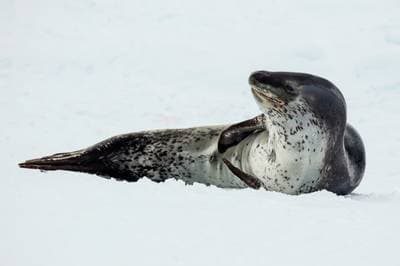
Leopard Seal
Hydrurga leptonyx
200–600 kg
12–26 yrs
pack_iceOceanCoast+1
Least Concern
🦬 Mammals
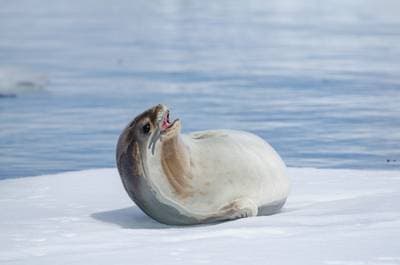
Ross Seal
Ommatophoca rossii
129–216 kg
15–25 yrs
pack_iceOceanopen_ocean