Least ConcernWaterbirds
Arctic Loon
Gavia arctica
The Arctic Loon (known as Black-throated Diver in Europe) is a majestic waterbird surrounded by mystique and natural beauty. With its elegant black-and-white plumage and distinctive red eye, the Arctic Loon is one of the most charismatic birds of the Nordic wilderness.
Robert Bergman (Public domain)
Learn together
Use this page to talk about conservation, habitat, and why each species matters.
Quick facts
Perfect for kids and families
⚖️Weight
1.5–3.4 kg
⏳Lifespan
15–30 yrs
🍽️Diet
Piscivore
⚡Top speed
75 km/h
Mini challenge
What does Arctic Loon usually eat?
Try together before you keep scrolling
Pick an answer
Weight
1.5–3.4 kg
Length
58–73 cm
Wingspan
1.1–1.4 m
Top Speed
75 km/h
Lifespan
15–30 yrs
Diet
Piscivore
Listen to this species
Ljud
Distribution map
Utbredning
Adventure step • Meet the species
Overview
The Arctic Loon (known as Black-throated Diver in Europe) is a majestic waterbird surrounded by mystique and natural beauty. With its elegant black-and-white plumage and distinctive red eye, the Arctic Loon is one of the most charismatic birds of the Nordic wilderness. During summer, the head and neck are adorned with characteristic grey plumage, while the back is covered with a checkerboard pattern of black and white. The Arctic Loon is perfectly adapted for aquatic life with its legs positioned far back on the body, making it an unbeatable swimmer and diver, but nearly helpless on land. This fascinating bird breeds on clear, fish-rich lakes in the Nordic forest region and tundra. The Arctic Loon is a skilled fisher that can dive to depths of 40 meters and stay underwater for up to two minutes. It hunts mainly fish such as perch, roach, and pike, but also takes crustaceans and insects when opportunity arises. During hunting, the Arctic Loon uses its sharp vision to scan for prey below the water surface, and once a target is spotted, it dives quickly and powerfully. The Arctic Loon's call is iconic and has inspired many Nordic tales and stories. The wailing, almost human-like cry that echoes across the water on summer nights has been described as one of nature's most magical sounds. The bird has an entire repertoire of calls – from the ghostly yodel to the long, mournful cry that can be heard kilometers away. These calls are used to mark territory, communicate with mates, and warn of dangers. The Arctic Loon is a migratory bird that spends winter along the coasts of the North Sea, Baltic Sea, and as far south as the Mediterranean. During migration they sometimes gather in small flocks, but in breeding areas they are strictly territorial. A pair of Arctic Loons may defend a territory of up to 100 hectares of water. The species is sensitive to human disturbance during breeding season, and boat wakes can destroy nests located near the waterline.
Adventure step • Where it lives
Habitat
LakeWetlandCoastOceanTundraTaiga
The Arctic Loon breeds on clear, oligotrophic to mesotrophic lakes in forested areas, mountain chains, and tundra. They prefer larger lakes with open water and abundant fish, often with archipelago characteristics and small islands or islets where they can build their nests. Lakes must be large enough to provide the long takeoff run the Arctic Loon needs to become airborne – typically at least 10-20 hectares. The nest is usually placed on an islet or at the shoreline, often on a small elevation or raft of plant material, always very close to water so the bird can quickly slide into the water when danger threatens. During winter, the Arctic Loon moves to the sea and coastal waters where it lives a completely different life. They can then be seen along open coasts of the North Sea, Baltic Sea, Atlantic, and Mediterranean. In winter plumage they are much more subdued with grey upperparts and white underparts, without the characteristic summer plumage. They may gather in loose flocks in fish-rich marine areas and dive for marine fish.
Adventure step • Through the seasons
Seasonal Behavior
The Arctic Loon arrives at its breeding lakes in April-May when the ice has broken up. Breeding takes place from May to August, and young are flight-capable in August-September. During autumn, from September to November, Arctic Loons migrate to their winter quarters along the coasts. Most Swedish Arctic Loons overwinter along coasts around the North Sea, Baltic Sea, and in some cases as far as the Mediterranean. During winter they molt into a more modest plumage with grey upperparts and white underparts. They return to the same lake year after year and often to the same nest.
Adventure step • Family life
Breeding
Incubation
29 days
Offspring
1–2
Adventure step • Wild behavior
Behavior & Ecology
Activity Pattern
Diurnal
Social Behavior
The Arctic Loon is strictly territorial during breeding season and defends a large territory around its nest. The pair bond is strong and they often breed together for many years.
Migration
Migratory
Population
The global population is estimated at 490,000–1,500,000 individuals, with approximately 5,000–7,000 breeding pairs in Sweden
Did you know?
Arctic Loons can dive to depths of 40 meters and stay underwater for up to 2 minutes!
Their call can be heard over 3 kilometers away and is one of the most recognizable sounds in Nordic nature.
Arctic Loons cannot walk on land – their legs are positioned so far back on their body that they can only crawl. But in water, they are masters!
When flying, the Arctic Loon can reach speeds of up to 75 km/h, but it needs a long takeoff run on the water before it can lift off.
Arctic Loon eyes have an extra layer that functions as built-in diving goggles when underwater.
Both parents incubate the eggs, and chicks can swim the day after hatching. They often ride on their parents' backs during the first weeks.
In Sweden there are approximately 5,000-7,000 breeding Arctic Loons, making it one of the more uncommon breeding birds.
The Arctic Loon can weigh up to 3.4 kg and is the second largest loon species in the world, after the Great Northern Diver.
Adventure step • Scientific place
Taxonomy
KingdomAnimalia
ClassAves
OrderGaviiformes
FamilyGaviidae
SpeciesGavia arctica
No sources have been added yet.
Cite this page
Fun Wild Facts (2026) Arctic Loon (Gavia arctica). https://www.funwildfacts.com/norden/bird/arctic-loon [May 30, 2026]
Similar animals
Least Concern
🦅 Waterbirds
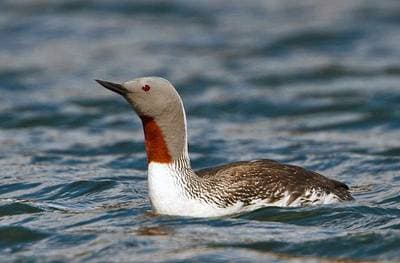
Red-throated Loon
Gavia stellata
1–2.5 kg
15–23 yrs
TundraWetlandLake+3
Least Concern
🦅 Birds
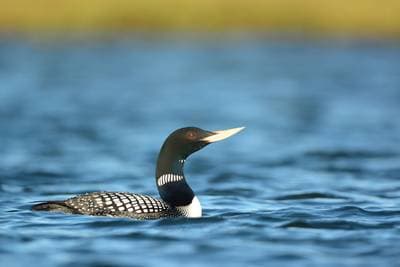
Yellow-billed Loon
Gavia adamsii
4–6.4 kg
15–30 yrs
TundraLakeCoast+2