Least Concern
Common Gartersnake
Thamnophis sirtalis
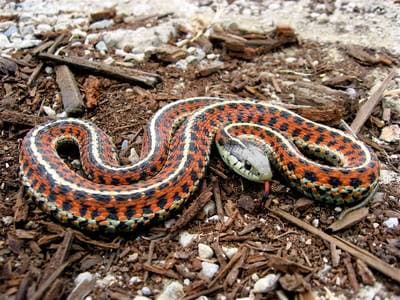
The common gartersnake (Thamnophis sirtalis) is one of North America's most widespread and abundant snakes. Its range extends from the cold forests of Canada in the north to the warmer climates of Mexico in the south, and from the Atlantic coast to the Pacific Ocean.
Wilson44691 (Public domain)
Learn together
Use this page to talk about conservation, habitat, and why each species matters.
Quick facts
Perfect for kids and families
⚖️Weight
35–150 g
⏳Lifespan
3–10 yrs
🍽️Diet
Omnivore
⚡Top speed
2.9 km/h
Mini challenge
What does Common Gartersnake usually eat?
Try together before you keep scrolling
Pick an answer
Weight
35–150 g
Length
0.46–1.37 m
Top Speed
2.9 km/h
Lifespan
3–10 yrs
Diet
Omnivore
Listen to this species
Ljud
Distribution map
Utbredning
Adventure step • Meet the species
Overview
The common gartersnake (Thamnophis sirtalis) is one of North America's most widespread and abundant snakes. Its range extends from the cold forests of Canada in the north to the warmer climates of Mexico in the south, and from the Atlantic coast to the Pacific Ocean. This adaptable serpent has successfully colonized an astonishing variety of habitats thanks to its ability to survive in both cold and warm climates. The name 'garter' comes from the snake's characteristic stripes, which resembled the striped garters that were popular in the 18th century for holding up stockings. The common gartersnake is a relatively small snake that typically reaches lengths between 46 and 66 centimeters, though some specimens can grow up to 137 centimeters long. It has three distinctive yellow or white stripes running the length of its body – one down the back and one on each side. The base color varies from black, brown, green, or olive-green, and between the stripes there is often a checkered pattern. This color variation is enormous; there are over 30 different subspecies with different color combinations. Some populations have red or orange stripes instead of yellow, while others can be almost entirely black. Unlike many other snakes, the common gartersnake is ovoviviparous, meaning it gives birth to live young instead of laying eggs. Females can give birth to between 10 and 85 offspring in a single litter, typically in July or August. The young are completely independent from birth and measure only 12-23 centimeters. The common gartersnake is an opportunistic hunter that eats a wide spectrum of prey, including earthworms, slugs, frogs, fish, salamanders, bird nestlings, and small rodents. A fascinating adaptation is that some populations have developed resistance to tetrodotoxin, the deadly poison found in rough-skinned newts. The common gartersnake is active during the day and loves to bask on rocks or near waterways. In winter, hundreds, sometimes thousands, of individuals gather in communal hibernation sites called hibernacula, often in rock crevices or old rodent burrows. When spring arrives, mass mating occurs directly outside these sites, where dozens of males may compete for a single female. The species is harmless to humans and rarely bites, but when threatened it can release a foul-smelling fluid from its anal glands. Despite its common occurrence, some local populations are threatened by habitat loss and road mortality.
Adventure step • Where it lives
Habitat
WetlandForestGrasslandFarmlandGardenUrbanWoodlandRiverLake
The common gartersnake is one of the world's most adaptable snakes and thrives in almost every conceivable habitat. It prefers moist areas near water such as wetlands, stream banks, ponds, lake shores, and swamp forests, but is also found in dry forests, grasslands, meadows, and even in city parks and gardens. The species has a particular fondness for habitats with plenty of basking spots such as rocks, logs, or open ground where it can regulate its body temperature. Proximity to water is important because many of the snake's prey animals, such as frogs and fish, live in or near water. The common gartersnake has shown extraordinary ability to adapt to human environments and is a common sight in suburbs and parks throughout North America. It is found from sea level to elevations over 2,400 meters in the mountains. During winter, the common gartersnake seeks frost-free locations such as rock crevices, stone piles, abandoned badger dens, or basements in old buildings. These hibernation sites, called hibernacula, may be used by the same population year after year for generations and are crucial for the species' survival in northern areas.
Adventure step • Through the seasons
Seasonal Behavior
The common gartersnake's annual cycle is marked by distinct seasonal patterns. In spring, typically from March to May depending on geographic location, the snakes awaken from winter dormancy and gather in large numbers outside the hibernacula for mating. This is when the dramatic 'mating balls' occur with dozens of males competing for each female. During summer, the snakes are most active and engage in intensive hunting and basking. Females undergo their pregnancy during summer and give birth to live young in July-August. In late summer and fall, the snakes feed heavily in preparation for winter. From October to November, as temperatures drop, the snakes return to their hibernation sites where they spend winter in a state of reduced metabolism together with hundreds of other individuals.
Adventure step • Family life
Breeding
Incubation
70 days
Offspring
10–85
Adventure step • Wild behavior
Behavior & Ecology
Activity Pattern
Diurnal
Social Behavior
Mainly solitary for most of the year, but forms large aggregations at hibernation sites and during mating season.
Migration
Resident
Population
Millions of individuals with stable population across the range
Did you know?
Some gartersnakes can eat poisonous newts that would kill most other predators – they've developed immunity to deadly toxins!
Thousands of gartersnakes can gather at the same hibernation site, creating spectacular 'mating balls' when they emerge in spring.
Males attract females by spreading pheromones, and sometimes small males disguise themselves by mimicking female scents to avoid larger males.
Gartersnakes are excellent swimmers and often dive to hunt fish and tadpoles underwater.
When a gartersnake is born, it's already fully functional and can hunt its first prey within hours.
Some populations of gartersnakes have blue tongues, while others have red or black ones.
The common gartersnake can survive in temperatures near freezing and is the snake that lives furthest north in the entire Western Hemisphere.
A threatened gartersnake can flatten its body to appear larger and more dangerous, while vibrating its tail like a rattlesnake.
Adventure step • Scientific place
Taxonomy
KingdomAnimalia
ClassSquamata
OrderSquamata
FamilyColubridae
SpeciesThamnophis sirtalis
No sources have been added yet.
Cite this page
Fun Wild Facts (2026) Common Gartersnake (Thamnophis sirtalis). https://www.funwildfacts.com/nordamerika/reptile/common-gartersnake [May 30, 2026]
Similar animals
Least Concern
🦎 Reptiles
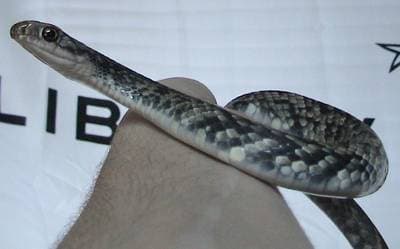
Black Racer
Coluber constrictor
0.15–0.6 kg
6–10 yrs
ForestGrasslandWoodland+4
Least Concern
🦎 Reptiles
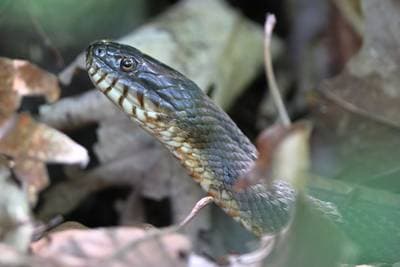
Common Watersnake
Nerodia sipedon
0.15–0.8 kg
8–10 yrs
WetlandRiverLake+2