Least Concern
Lesser Mouse-deer
Tragulus javanicus
The Lesser Mouse-deer (Tragulus javanicus), also known as the Kanchil or Chevrotain, is one of the world's smallest hoofed mammals. This enchanting animal weighs only 1.5-2.5 kilograms and is roughly the size of a rabbit.
Levg (CC BY-SA 3.0)
Learn together
Use this page to talk about conservation, habitat, and why each species matters.
Quick facts
Perfect for kids and families
⚖️Weight
1.5–2.5 kg
⏳Lifespan
10–14 yrs
🍽️Diet
Herbivore
⚡Top speed
25 km/h
Mini challenge
What does Lesser Mouse-deer usually eat?
Try together before you keep scrolling
Pick an answer
Weight
1.5–2.5 kg
Length
40–50 cm
Height
20–25 cm
Top Speed
25 km/h
Lifespan
10–14 yrs
Diet
Herbivore
Listen to this species
Ljud
Distribution map
Utbredning
Adventure step • Meet the species
Overview
The Lesser Mouse-deer (Tragulus javanicus), also known as the Kanchil or Chevrotain, is one of the world's smallest hoofed mammals. This enchanting animal weighs only 1.5-2.5 kilograms and is roughly the size of a rabbit. Despite its name, it is not a true deer but belongs to the family Tragulidae, known as chevrotains or mouse-deer. With its slender legs, pointed snout, and large, dark eyes, the Lesser Mouse-deer looks like a miniature creature straight from a fairy tale. This nocturnal animal lives in the dense rainforests of Southeast Asia, particularly on Java, Sumatra, Borneo, and surrounding islands. The Lesser Mouse-deer is a master at sneaking through thick undergrowth, and its compact body allows it to navigate through brush where larger animals cannot reach. Unlike true deer, males lack antlers. Instead, they have long, sharp canine teeth that can grow up to 7.5 centimeters long and protrude from the upper jaw like small tusks. These are used to defend territories and compete for females. The Lesser Mouse-deer is strictly herbivorous, feeding on fallen fruits, leaves, young shoots, and fungi. It spends its days hidden in dense bushes or hollow tree trunks, emerging only at dusk to feed. With exceptional hearing and sensitivity to vibrations, it can quickly detect predators such as snakes, birds of prey, leopards, and wild cats. When sensing danger, it first freezes completely still, relying on its brownish coat color for camouflage. Unfortunately, the Lesser Mouse-deer is threatened by habitat loss due to deforestation and conversion of rainforest to agricultural land. It is also hunted for its meat in some areas. Although not yet classified as critically endangered, the population is steadily declining, and protection of Southeast Asia's rainforests is crucial for the species' survival.
Adventure step • Where it lives
Habitat
RainforestForestMangroveWetland
The Lesser Mouse-deer thrives in dense tropical rainforests, mangrove forests, and humid lowland areas of Southeast Asia. It prefers areas with thick undergrowth where it can hide from predators during the day. These animals are often found near waterways, as they are skilled swimmers and use water as an escape route. They live from sea level up to approximately 2,000 meters elevation in montane forests. Their habitat is characterized by tall trees, dense leaf cover, and abundant rainfall year-round. The Lesser Mouse-deer is particularly dependent on forest floors where fruit falls, as fallen fruit comprises an important part of their diet. Forest fragmentation and human settlement pose serious threats to their natural habitat.
Adventure step • Through the seasons
Seasonal Behavior
Because the Lesser Mouse-deer lives in equatorial rainforests where the climate is stable and warm year-round, it lacks pronounced seasonal variation in behavior. There is no specific breeding season, and young can be born at any time of the year. However, fruit production in the forest may vary somewhat, affecting food availability. During periods of abundant fruit, the Lesser Mouse-deer may gain some weight, while leaner periods require more active foraging.
Adventure step • Family life
Breeding
Gestation
140 days
Offspring
1–1
Adventure step • Wild behavior
Behavior & Ecology
Activity Pattern
Nocturnal
Social Behavior
The Lesser Mouse-deer is a distinctly solitary animal that only seeks out other individuals during mating. Males are territorial and mark their areas with scent glands.
Migration
Resident
Population
Population size is unknown, but the species is considered to be declining due to habitat loss and hunting.
Did you know?
The Lesser Mouse-deer is about the size of a rabbit and is one of the world's smallest hoofed mammals!
Males don't have antlers but instead have long protruding fangs – earning them the nickname 'vampire deer'!
When frightened, the Lesser Mouse-deer can jump nearly one meter straight up in the air and then run in zigzag patterns to confuse predators.
Despite its tiny size, the Lesser Mouse-deer is an excellent swimmer and often escapes into water to flee from danger.
In Indonesian folklore, the Kanchil is a clever and intelligent hero who outwits larger animals with cunning.
The Lesser Mouse-deer has four stomach chambers just like cows and other ruminants, despite being so small.
Their large eyes help them see in the dark when foraging for food at night.
A Lesser Mouse-deer can communicate by stamping its hind feet on the ground to warn others of danger.
Adventure step • Scientific place
Taxonomy
KingdomAnimalia
ClassMammalia
OrderArtiodactyla
FamilyTragulidae
SpeciesTragulus javanicus
No sources have been added yet.
Cite this page
Fun Wild Facts (2026) Lesser Mouse-deer (Tragulus javanicus). https://www.funwildfacts.com/asien/mammal/lesser-mouse-deer [May 30, 2026]
Similar animals
Endangered
🦬 Ungulates
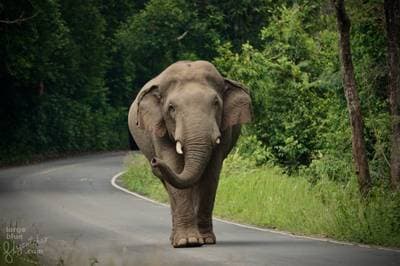
Asian Elephant
Elephas maximus
2700–5000 kg
48–70 yrs
ForestGrasslandRainforest+1
Endangered
🦬 Ungulates
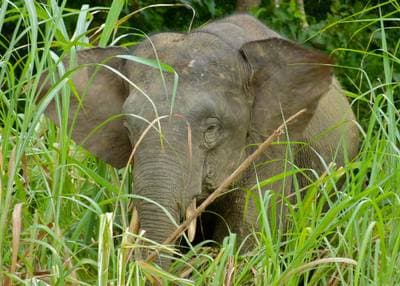
Borneo Elephant
Elephas maximus borneensis
2000–3000 kg
55–70 yrs
ForestWetlandGrassland