Least Concern
Lesser Horseshoe Bat
Rhinolophus hipposideros
The lesser horseshoe bat is Europe's smallest bat species and one of the most distinctive. Weighing just 4-7 grams (about the weight of a sugar cube) with a wingspan of 19-25 centimeters, this tiny mammal is perfectly adapted for life on the wing.
João Manuel Lemos Lima (CC BY 4.0)
Learn together
Use this page to talk about conservation, habitat, and why each species matters.
Quick facts
Perfect for kids and families
⚖️Weight
4–7 g
⏳Lifespan
4–21 yrs
🍽️Diet
Insectivore
⚡Top speed
20 km/h
Mini challenge
What does Lesser Horseshoe Bat usually eat?
Try together before you keep scrolling
Pick an answer
Weight
4–7 g
Length
3.5–4.5 cm
Wingspan
19–25 cm
Top Speed
20 km/h
Lifespan
4–21 yrs
Diet
Insectivore
Listen to this species
Ljud
Distribution map
Utbredning
Adventure step • Meet the species
Overview
The lesser horseshoe bat is Europe's smallest bat species and one of the most distinctive. Weighing just 4-7 grams (about the weight of a sugar cube) with a wingspan of 19-25 centimeters, this tiny mammal is perfectly adapted for life on the wing. The species gets its name from the characteristic horseshoe-shaped nose-leaf that surrounds its nostrils. This unique facial structure acts as a parabolic reflector, focusing the ultrasonic calls used for echolocation. Unlike most bats that emit calls through their mouths, horseshoe bats use their noses, making their echolocation system remarkably efficient. The bat's fur varies from grey-brown to reddish on the back, with a paler underside. The ears are relatively large and pointed, and the broad wings give the bat an exceptionally maneuverable, almost butterfly-like flight. It can even hover in place while catching insects. The lesser horseshoe bat has developed a unique hunting strategy called 'perch hunting,' where it hangs from twigs or rocks and waits for prey to fly past before making a swift attack. During summer months, the species inhabits cave entrances, old buildings, bridges, and rock crevices where it forms colonies. Females gather in maternity roosts to give birth, while males typically live more solitary lives. In winter, they seek humid caves and cellars with stable temperatures between 2-9 degrees Celsius. Here they enter hibernation and can reduce their heart rate from 400 beats per minute to just a few. The lesser horseshoe bat is threatened throughout much of its range due to habitat loss, disturbance at roost sites, and declining insect populations. The species is particularly sensitive to disturbance during hibernation, as repeated awakening can deplete fat reserves and lead to death. In Sweden, the species is extremely rare with only sporadic observations, but it occurs across Europe from Ireland and southern England to the Mediterranean and east to the Caucasus.
Adventure step • Where it lives
Habitat
ForestWoodlandFarmlandGardenUrbanMountaincave
The lesser horseshoe bat prefers open landscapes with woodland, pastures, and wetlands where insects are abundant. It hunts along forest edges, hedgerows, waterways, and in gardens where insect density is high. The species is sensitive to landscape changes and requires a varied landscape with both foraging areas and suitable roost sites. Summer colonies are established in warm attics of buildings, cave entrances, or hollow trees. Winter roosts must have stable temperatures and high humidity, typically deep caves, cellars, or rock crevices. The species has declined dramatically in many areas where old buildings have been renovated and natural cave environments have been disturbed by visitors.
Adventure step • Through the seasons
Seasonal Behavior
In spring (April-May), the lesser horseshoe bat emerges from hibernation and females gather in maternity roosts where they give birth to their young in June-July after a gestation period of about 75 days. Pups can fly after 3-4 weeks but stay with their mothers longer. During summer, the bats hunt actively every night and build up fat reserves. From September-October they begin preparing for winter by eating extra amounts. Hibernation lasts from October to April depending on climate, and during this period they only wake sporadically. The species sometimes makes short migrations between summer and winter roosts, usually 5-30 kilometers but occasionally up to 150 kilometers.
Adventure step • Family life
Breeding
Gestation
75 days
Offspring
1–1
Adventure step • Wild behavior
Behavior & Ecology
Activity Pattern
Nocturnal
Social Behavior
Forms maternity colonies of 10-100 females during summer, while males live more solitarily.
Migration
Partial Migrant
Population
Unknown global population, but declining in many regions
Did you know?
The lesser horseshoe bat is Europe's smallest bat species, weighing as little as a sugar cube!
It can eat up to half its own body weight in insects each night – equivalent to a human eating 40 kg of food daily!
Its ultrasonic calls reach frequencies up to 113 kHz, far beyond human hearing which stops around 20 kHz.
A lesser horseshoe bat can live over 20 years, remarkably long for such a small mammal.
It often hangs upside down from twigs with its legs spread wide, looking like it's doing the splits!
During winter hibernation, its heart rate can drop from 400 beats per minute to fewer than 10.
Females give birth to only one pup per year, making the species extra vulnerable to population decline.
It can maneuver so skillfully in flight that it catches tiny midges in complete darkness.
Adventure step • Scientific place
Taxonomy
KingdomAnimalia
ClassMammalia
OrderChiroptera
FamilyRhinolophidae
SpeciesRhinolophus hipposideros
No sources have been added yet.
Cite this page
Fun Wild Facts (2026) Lesser Horseshoe Bat (Rhinolophus hipposideros). https://www.funwildfacts.com/europa/mammal/lesser-horseshoe-bat [May 30, 2026]
Similar animals
Least Concern
🦬 Mammals
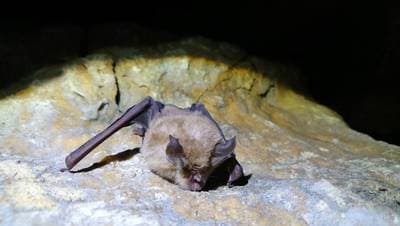
Greater Horseshoe Bat
Rhinolophus ferrumequinum
17–34 g
10–30 yrs
ForestWoodlandGrassland+4
Least Concern
🦬 Mammals
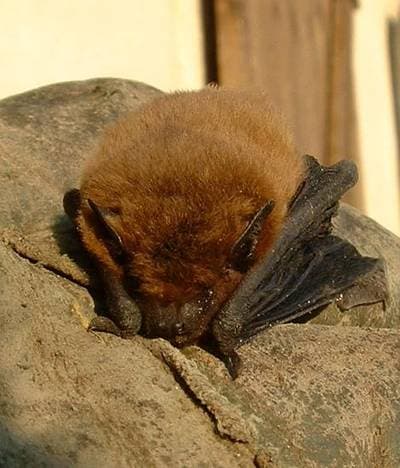
45 Khz Pipistrelle
Pipistrellus pipistrellus
3.5–8 g
4–16 yrs
ForestWetlandWoodland+7