Least Concern
Sowerby's Beaked Whale
Mesoplodon bidens
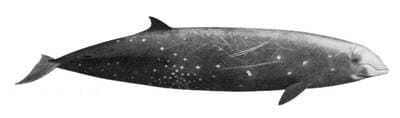
Sowerby's beaked whale is one of the most mysterious deep-sea mammals swimming in the cold waters of the North Atlantic. With its slender body and characteristic long, narrow beak, this whale is a master deep-diver that can hold its breath for over an hour.
Thorburn, Archibald (Public domain)
Learn together
Use this page to talk about conservation, habitat, and why each species matters.
Quick facts
Perfect for kids and families
⚖️Weight
900–1400 kg
⏳Lifespan
27–37 yrs
🍽️Diet
Carnivore
⚡Top speed
25 km/h
Mini challenge
What does Sowerby's Beaked Whale usually eat?
Try together before you keep scrolling
Pick an answer
Weight
900–1400 kg
Length
4–5 m
Top Speed
25 km/h
Lifespan
27–37 yrs
Diet
Carnivore
Listen to this species
Ljud
Distribution map
Utbredning
Adventure step • Meet the species
Overview
Sowerby's beaked whale is one of the most mysterious deep-sea mammals swimming in the cold waters of the North Atlantic. With its slender body and characteristic long, narrow beak, this whale is a master deep-diver that can hold its breath for over an hour. The species was first discovered in 1800 when a stranded individual was found on the Scottish coast, and it is named after the English naturalist James Sowerby. Despite having been known for over 200 years, scientists still know very little about its lifestyle, as it is rarely seen at the surface and lives in remote ocean areas. This beaked whale is approximately 4-5 meters long and weighs between 900 and 1,400 kilograms. The body is dark gray to grayish-brown on the upper side and somewhat lighter on the underside, often with peculiar light patches that may be scars from fights or parasites. The most distinctive feature is the two narrow teeth that only the male possesses, which protrude in the middle of the lower jaw like small tusks. These teeth are probably used for dominance battles between males, as many older males bear scars on their bodies. The female has no visible teeth at all, making it easy to distinguish between the sexes if one gets the chance to see them up close. Sowerby's beaked whale is an exceptional diver that regularly seeks food at depths between 200 and 1,500 meters below the ocean surface. It lives mainly on squid and deep-sea fish that it catches in complete darkness. To navigate and find prey in this dark realm, the whale uses echolocation – it sends out clicking sounds and listens for echoes that bounce back from objects in the water. A dive can last over 30 minutes, and some researchers believe the species can dive even deeper and longer than we have observed so far. When whales come up to the surface to breathe, they are often very cautious and show only a small part of the head and back. This species is extremely difficult to study in the wild because it avoids vessels and rarely shows itself at the surface. Most of our knowledge comes from stranded individuals, meaning many aspects of their lives remain a mystery. Sowerby's beaked whale occurs from the Arctic Ocean down to the Canary Islands, with particularly many observations off Norway, Iceland, and Scotland. The species is considered sensitive to underwater noise from military sonar and seismic surveys, which can disrupt their echolocation and cause strandings. Climate change's impact on deep-sea environments may also threaten their future.
Adventure step • Where it lives
Habitat
Ocean
Sowerby's beaked whale is a true deep-sea mammal that prefers temperate and cold waters in the North Atlantic. The species is found mainly over the continental shelf slopes and in areas with deep water, usually between 200 and 3,000 meters depth. They prefer water temperatures between 4 and 15 degrees Celsius and appear to avoid both very warm and completely Arctic waters. In Nordic waters, they are most often seen off the Norwegian coast, around Iceland, and in the deep-sea waters west of Scotland and Ireland. These whales are rarely seen near the coast and generally avoid shallow waters. They spend most of their time far out to sea where they hunt squid and deep-sea species in almost total darkness. The topography of the ocean floor appears to be important to them – they prefer areas with steep underwater slopes and deep canyons where their prey species are common. During certain seasons they may move closer to the continental shelves to follow food banks, but they remain in deep water even then.
Adventure step • Through the seasons
Seasonal Behavior
Sowerby's beaked whale's seasonal patterns are still poorly understood, but some observations suggest they move toward more northerly waters in summer and more southerly waters in winter. Strandings appear to be most common during autumn and winter, especially along the North Sea coasts, which may indicate seasonal migration or changes in their food banks. Calving is believed to occur during spring and summer after a gestation period of about one year. The calf probably nurses for 9-12 months, and the female gives birth to only one calf every two or three years. Climate change's impact on deep-sea environments may affect their seasonal patterns in the future.
Adventure step • Family life
Breeding
Gestation
365 days
Offspring
1–1
Adventure step • Wild behavior
Behavior & Ecology
Activity Pattern
Diurnal
Social Behavior
Sowerby's beaked whale is usually observed alone or in small groups of 2-3 individuals, often consisting of a female with calf or a pair of adults. Larger gatherings are rare but have occasionally been reported.
Migration
Partial Migrant
Population
Estimated population unknown, possibly 10,000-100,000 individuals in the North Atlantic, but data is very uncertain due to the species' difficulty to study
Did you know?
Sowerby's beaked whale can hold its breath for over 60 minutes during deep dives – longer than most other whales!
Only males have visible teeth, and they don't use them for eating but probably for fighting with other males.
The species is so shy that researchers almost never see living individuals – most of what we know comes from stranded whales.
They can dive down to over 1,500 meters depth where the pressure is almost 150 times higher than at the surface!
Many beaked whales have peculiar white patches and scars from fights, parasites, or squid suckers.
The first Sowerby's beaked whale ever documented was found stranded in Scotland in 1800.
These whales produce high-frequency clicking sounds for echolocation that are so high-pitched that humans cannot hear them.
A newborn calf is about 2.4 meters long – almost half as long as its mother already at birth!
Adventure step • Scientific place
Taxonomy
KingdomAnimalia
ClassMammalia
OrderCetacea
FamilyHyperoodontidae
SpeciesMesoplodon bidens
No sources have been added yet.
Cite this page
Fun Wild Facts (2026) Sowerby's Beaked Whale (Mesoplodon bidens). https://www.funwildfacts.com/norden/mammal/sowerby-s-beaked-whale [May 30, 2026]
Similar animals
Least Concern
🦬 Mammals
Baird's Beaked Whale
Berardius bairdii
9000–15000 kg
50–84 yrs
Ocean
Least Concern
🦬 Mammals
Blainville's Beaked Whale
Mesoplodon densirostris
800–1200 kg
27–45 yrs
Ocean