Least Concern
Purple Hairstreak
Quercusia quercus
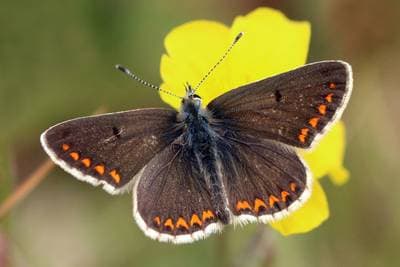
The Purple Hairstreak is a fascinating small butterfly that lives in close symbiosis with oak trees. With a wingspan of just 2.6-3.4 centimeters, it belongs to the gossamer-winged butterfly family Lycaenidae, and its life is intimately connected to oaks.
Didier Descouens (CC BY-SA 3.0)
Learn together
Use this page to talk about conservation, habitat, and why each species matters.
Quick facts
Perfect for kids and families
⚖️Weight
0.001–0.002 g
⏳Lifespan
0.041–0.082 yrs
🍽️Diet
Herbivore
🛡️Status
Least Concern
Mini challenge
What does Purple Hairstreak usually eat?
Try together before you keep scrolling
Pick an answer
Weight
0.001–0.002 g
Length
1.3–1.8 cm
Wingspan
2.6–3.4 cm
Lifespan
0.041–0.082 yrs
Diet
Herbivore
Listen to this species
Ljud
Distribution map
Utbredning
Adventure step • Meet the species
Overview
The Purple Hairstreak is a fascinating small butterfly that lives in close symbiosis with oak trees. With a wingspan of just 2.6-3.4 centimeters, it belongs to the gossamer-winged butterfly family Lycaenidae, and its life is intimately connected to oaks. Males are particularly beautiful with metallic purple upper wing surfaces that shimmer in sunlight, while females have more subdued dark brown wings with only a faint purple sheen. The undersides of both sexes are grayish with white streaks and orange spots near the hind wing margin. This species has a very special life cycle that is completely dependent on oak trees. Females lay their eggs in the scales of oak buds, where the larvae overwinter before hatching in spring. The newly hatched caterpillars begin by eating oak buds and male flowers, but later develop a remarkable partnership with ants. The larvae secrete a sweet liquid that ants love, and in exchange, the ants protect the larvae from predators. This mutualistic relationship continues even when the larva transforms into a pupa among leaves and debris at the oak's base. The Purple Hairstreak is remarkably faithful to its tree and rarely leaves the oak canopy. The butterflies spend most of their lives high in the treetops where they bask, mate, and seek nourishment. Males are territorial and aggressively patrol their domain in the canopy, often sitting on exposed branches where they can survey their territory. They fly primarily during afternoons and early evenings when the sun warms the oak canopy. In Europe, the Purple Hairstreak occurs wherever mature oaks are found, from southern Scandinavia south through central and southern Europe to the Mediterranean, and east into Asia Minor. Despite being relatively common, it is often difficult to spot because it spends so much time high in the treetops. The species serves as an excellent indicator of valuable oak habitats and old-growth oak woodlands.
Adventure step • Where it lives
Habitat
ForestWoodlandHeathlandFarmlandGarden
The Purple Hairstreak is completely dependent on oak trees for survival and therefore occurs only where these trees grow. The species thrives best in sunny, warm environments with old, thick-barked oaks that provide abundant buds and catkins for the larvae. Ideal habitats include oak pastures, parklands, tree-lined avenues, woodland edges, and open oak forests where trees receive sufficient sun to develop large canopies. In the Nordic countries, the Purple Hairstreak is found mainly in the southern parts where oak is common, but it can also be encountered locally further north where isolated oak stands occur. The species benefits from traditional pasture management and park-like environments where old oaks are allowed to remain. Modern forestry practices that fell old oaks before they reach great age can negatively impact populations, making the species a good indicator of valuable oak habitats. In Denmark and southern Sweden it is relatively common in suitable habitats, while becoming more sporadic in northern areas.
Adventure step • Through the seasons
Seasonal Behavior
The Purple Hairstreak has one generation per year and flies mainly during high summer, from late June to early September, with a peak in July-August. Adult butterflies live only 2-3 weeks, but the species' life cycle extends over a full year. Eggs are laid in late summer in the scales of oak buds, where they overwinter exposed to cold and weather. Larvae hatch in spring when the oak buds burst, usually in April-May, and then feed on young leaves and male flowers. The larval stage lasts about 6-8 weeks before pupation occurs in June, often among leaves at the tree's base. After 2-3 weeks the adult butterflies emerge, and the cycle begins again. During warm summer days, activity is greatest in the afternoon and evening when the sun warms the oak canopy.
Adventure step • Family life
Breeding
Offspring
50–150
Adventure step • Wild behavior
Behavior & Ecology
Activity Pattern
Diurnal
Social Behavior
Males are highly territorial and aggressively defend selected branches in the oak canopy. Females are more solitary and focused on finding suitable egg-laying sites among oak buds.
Migration
Resident
Population
Common and stable throughout its range where suitable oaks are present
Did you know?
Males have a spectacular purple iridescence on their wings that is only visible in the right light and angle – in shade they appear almost black!
They spend almost their entire lives in the oak canopy and rarely descend to the ground, making them difficult to observe despite being quite common.
The caterpillars have a special 'honey gland' that produces sweet liquid to reward ants that protect them from predators.
A female can lay 50-150 eggs, but places only one or two eggs per bud so the larvae don't compete with each other.
The eggs overwinter for up to 9 months before hatching – longer than the butterfly's own adult lifespan!
Purple Hairstreaks can distinguish between different oak species and prefer English oak over other varieties.
Adult butterflies rarely drink nectar from flowers, instead living mainly on dew, honeydew from aphids, and tree sap.
Males can become so aggressive in territorial defense that they even attack birds that fly too close to their oak canopy!
Adventure step • Scientific place
Taxonomy
KingdomAnimalia
ClassInsecta
OrderLepidoptera
FamilyLycaenidae
SpeciesQuercusia quercus
No sources have been added yet.
Cite this page
Fun Wild Facts (2026) Purple Hairstreak (Quercusia quercus). https://www.funwildfacts.com/norden/insect/purple-hairstreak [May 30, 2026]
Similar animals
Least Concern
🦋 Insects
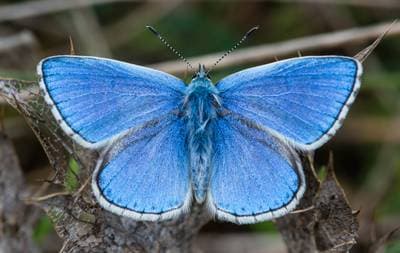
Adonis Blue
Lysandra bellargus
0.00025–0.0004 g
0.041–0.082 yrs
GrasslandHeathlandFarmland
Least Concern
🦋 Insects
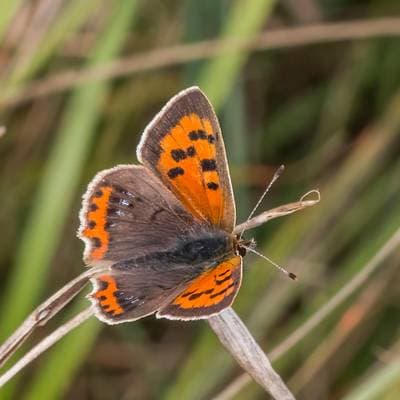
American Copper
Lycaena phlaeas
0.001–0.002 g
0.014–0.082 yrs
GrasslandHeathlandFarmland+5