Least Concern
Essex Skipper
Thymelicus lineola
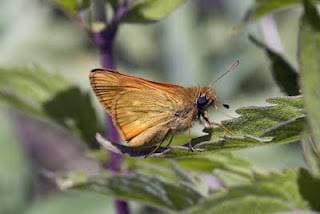
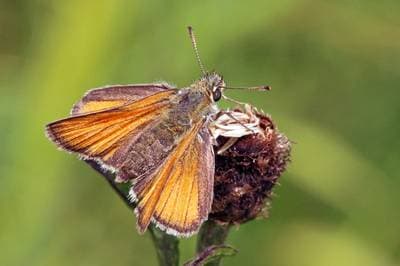
The Essex Skipper (Thymelicus lineola) is a small but fascinating butterfly belonging to the family Hesperiidae, commonly known as the skipper family. This species is renowned for its fast, darting flight pattern and characteristic appearance with orange-yellow wings.
Michael Apel (CC BY-SA 2.5)
Learn together
Use this page to talk about conservation, habitat, and why each species matters.
Quick facts
Perfect for kids and families
⚖️Weight
0.00015–0.00025 g
⏳Lifespan
0.019–0.082 yrs
🍽️Diet
Herbivore
🛡️Status
Least Concern
Mini challenge
What does Essex Skipper usually eat?
Try together before you keep scrolling
Pick an answer
Weight
0.00015–0.00025 g
Length
1.1–1.5 cm
Wingspan
2.4–2.9 cm
Lifespan
0.019–0.082 yrs
Diet
Herbivore
Listen to this species
Ljud
Distribution map
Utbredning
Adventure step • Meet the species
Overview
The Essex Skipper (Thymelicus lineola) is a small but fascinating butterfly belonging to the family Hesperiidae, commonly known as the skipper family. This species is renowned for its fast, darting flight pattern and characteristic appearance with orange-yellow wings. The butterfly received its English name when it was first discovered in Essex, England, in 1889, but the species has since spread across much of Europe and parts of Asia. With a wingspan reaching 24-29 millimeters, it is one of the smaller butterflies found in northern regions. One of the most distinctive features of this species is the underside of the antenna tips, which are jet black – a detail that distinguishes it from the very similar Small Skipper (Thymelicus sylvestris), which has orange-brown antenna tips. The wings are orange-yellow to golden-brown on the upper side with darker margins, while males have a distinct black scent-scale brand on the upper side of the forewing. The body is robust and covered with hair, which is typical of the skipper family. The butterfly's large, dark compound eyes give it excellent vision for detecting both floral resources and potential mates. The Essex Skipper undergoes complete metamorphosis (holometabolous development) from egg through larva and pupa to adult butterfly. The larva is green with a darker dorsal line and lives hidden in folded grass blades. It overwinters as an egg in the grass sheath, which is a unique adaptation that distinguishes the species from many other butterflies. The larva feeds primarily on various grass species, particularly Timothy grass (Phleum pratense) and Cock's-foot (Dactylis glomerata). Pupation occurs in a loose silk cocoon among grass stems during early summer. The species has expanded its range dramatically in recent decades, likely as a result of climate change and increased temperatures. In Scandinavia, it is now regularly found in southern Sweden and Denmark, with occasional observations further north. The population is considered stable in most parts of Europe, where the species benefits from meadows, roadsides, and other grass-rich habitats that are not treated with pesticides.
Adventure step • Where it lives
Habitat
GrasslandFarmlandGardenHeathlandWoodland
The Essex Skipper thrives in open, sunny grasslands with rich floral diversity. The species prefers meadows, pastures, roadside verges, railway embankments, and other habitats where grasses are allowed to grow tall and flower. It is often found in cultural landscapes where traditional mowing or grazing maintains a mosaic of short and tall grass. The butterfly is particularly common on calcareous soils and in areas with good access to nectar-rich flowers. In Scandinavia, the species is mainly found in lowlands and coastal areas in southern Sweden and Denmark. It avoids shady forest areas and overly intensively farmed agricultural land. Suitable habitats are characterized by variation in vegetation height, good sun exposure, and the presence of both host plants for the larvae (various grass species) and nectar plants for adult butterflies. The species benefits from extensive management that promotes biodiversity, such as late mowing and limited use of pesticides.
Adventure step • Through the seasons
Seasonal Behavior
Adult butterflies fly mainly from late June to early August, with peak numbers in July. This is the period when females lay their eggs in grass sheaths. The eggs overwinter and hatch only in April-May of the following year when temperatures rise. The larvae undergo several molts during May and June before pupating. The pupal stage lasts about 2-3 weeks before the new generation of adult butterflies emerges in late June. The species has only one generation per year in Scandinavia, but in warmer climates further south, two generations may occur.
Adventure step • Family life
Breeding
Incubation
21 days
Offspring
50–150
Adventure step • Wild behavior
Behavior & Ecology
Activity Pattern
Diurnal
Social Behavior
Males are territorial and actively defend their territories against other males through rapid aerial chases. Adult butterflies are diurnal and most active in sunny, warm weather.
Migration
Resident
Population
Stable and locally common in southern Scandinavia, with expanding range northward
Did you know?
The underside of the antenna tips is jet black – this is the most reliable way to distinguish the species from the very similar Small Skipper!
The butterfly can fly at speeds up to 15 kilometers per hour despite its small size, making rapid, jerky wingbeats that give the family its 'skipper' name.
The eggs overwinter inside the grass sheath and don't hatch until the following spring – the larva spends the entire winter as a tiny egg!
Males are highly territorial and patrol their territories from strategic lookout posts on tall grass stems or flowers.
The species was first discovered in England in 1889 but has since spread across all of Britain and further north in Europe.
The larva only feeds at night and rests hidden in a folded grass blade during the day to avoid predators.
Adult butterflies love to visit purple and pink flowers, especially thistles, knapweeds, and wild thyme.
A single female can lay between 50 and 150 eggs during her short adult lifespan, which lasts only 2-3 weeks!
Adventure step • Scientific place
Taxonomy
KingdomAnimalia
ClassInsecta
OrderLepidoptera
FamilyHesperiidae
SpeciesThymelicus lineola
No sources have been added yet.
Cite this page
Fun Wild Facts (2026) Essex Skipper (Thymelicus lineola). https://www.funwildfacts.com/norden/insect/essex-skipper [May 30, 2026]
Similar animals
Least Concern
🦋 Insects
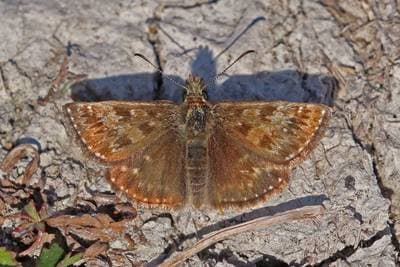
Dingy Skipper
Erynnis tages
0.0002–0.0004 g
0.027–0.082 yrs
GrasslandHeathlandWoodland+2
Least Concern
🦋 Insects
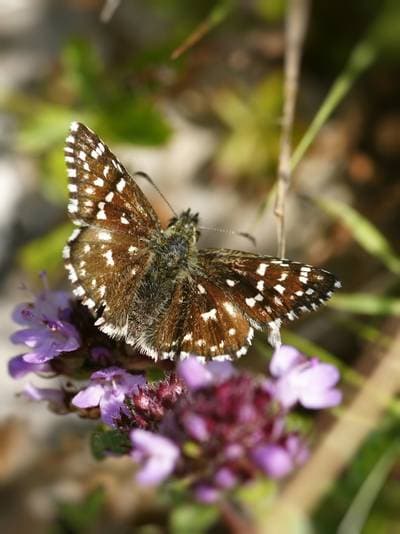
Grizzled Skipper
Pyrgus malvae
0.0002–0.0003 g
0.027–0.055 yrs
GrasslandHeathlandWoodland+3