Least Concern
European Mink
Mustela lutreola
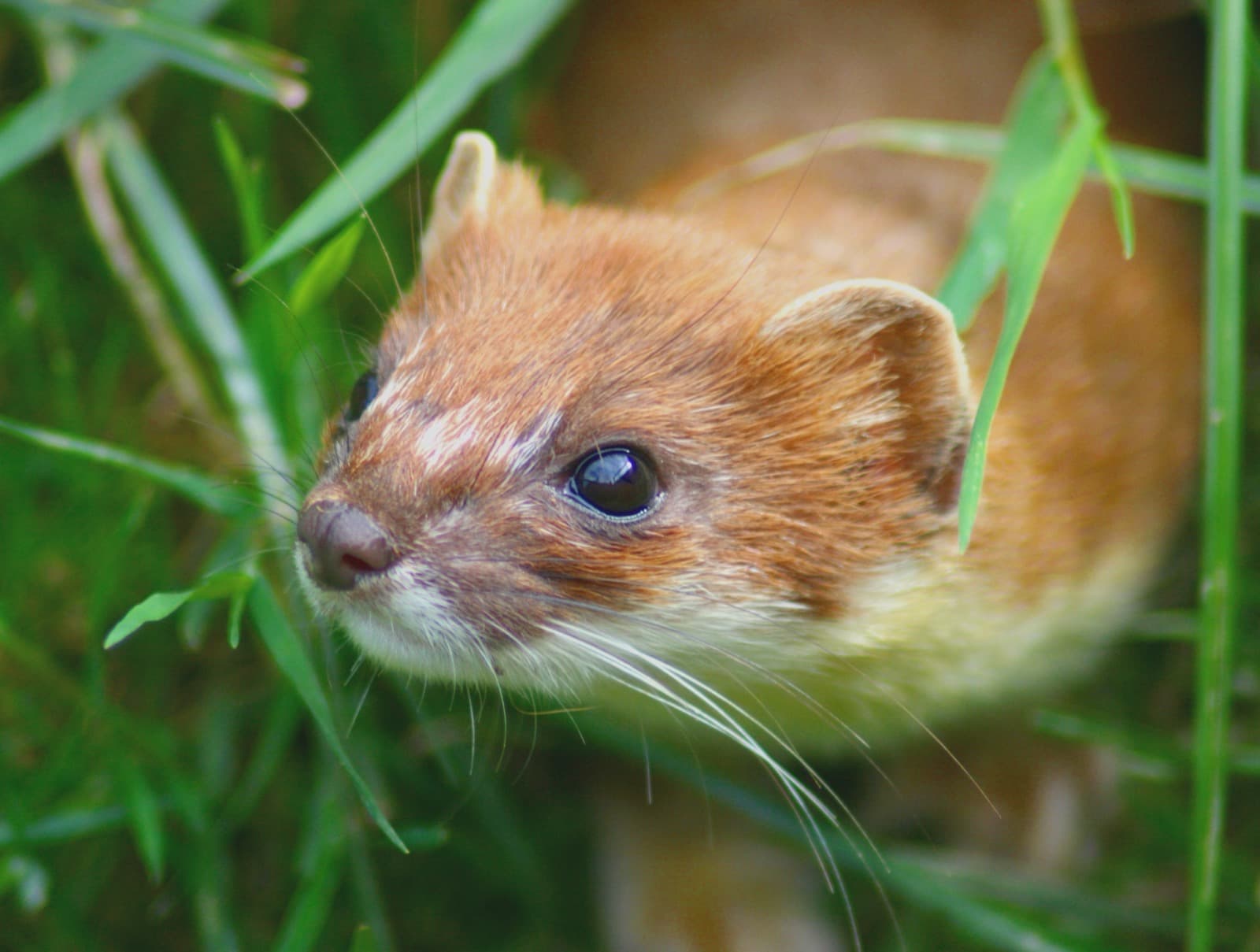
The European mink is one of Europe's most endangered mammals and belongs to the weasel family Mustelidae. With its chestnut to dark brown fur and the characteristic white patch on both the upper and lower lips, the European mink is easily distinguished from the invasive American mink.
photo taken by: Nicolai Meyer (Attribution)
Learn together
Use this page to talk about conservation, habitat, and why each species matters.
Quick facts
Perfect for kids and families
⚖️Weight
0.4–0.74 kg
⏳Lifespan
4–10 yrs
🍽️Diet
Carnivore
🛡️Status
Least Concern
Mini challenge
What does European Mink usually eat?
Try together before you keep scrolling
Pick an answer
Weight
0.4–0.74 kg
Length
28–43 cm
Lifespan
4–10 yrs
Diet
Carnivore
Listen to this species
Ljud
Distribution map
Utbredning
Adventure step • Meet the species
Overview
The European mink is one of Europe's most endangered mammals and belongs to the weasel family Mustelidae. With its chestnut to dark brown fur and the characteristic white patch on both the upper and lower lips, the European mink is easily distinguished from the invasive American mink. This small carnivorous semi-aquatic mammal weighs between 400 and 740 grams and reaches a length of 28-43 centimeters, plus a 12-19 centimeter long tail. Its fur is dense and waterproof, making it perfectly adapted for a life in and near water. The European mink is strongly associated with freshwater environments and prefers slow-flowing rivers, streams, and lakes with rich vegetation along the banks. The animal is a skilled swimmer and diver that moves as confidently in water as on land. During the 20th century, the species declined dramatically throughout its range, primarily due to habitat destruction, persecution, and competition from the introduced American mink, which is larger and more aggressive. Today, viable populations exist only in isolated areas of France, Spain, Romania, and parts of Russia. This crepuscular animal is most active at dawn and dusk when it hunts for fish, amphibians, crustaceans, and small rodents. The European mink is an opportunistic hunter that adapts its diet to what is available in its territory. Each individual maintains a territory along watercourses that can extend several kilometers. They communicate through scent marking and vocalizations, and are known to be cautious and difficult to observe in nature. The species' critical conservation status has led to several rescue efforts across Europe, including breeding programs and reintroduction projects. In Estonia and Spain, special efforts are underway to preserve and restore populations. The European mink is classified as Critically Endangered by the IUCN, and without extensive conservation measures, the species risks disappearing completely from the European mainland within the coming decades.
Adventure step • Where it lives
Habitat
WetlandRiverLakeForestWoodland
The European mink is specialized for freshwater environments and requires specific habitat conditions to survive. The species prefers slow-flowing rivers and streams with rich vegetation cover along the banks, preferably with willow bushes, reeds, and overhanging trees that provide shelter and shade. Water quality is crucial - the mink needs clean water with good visibility to hunt effectively, as well as an abundant occurrence of prey animals such as fish, amphibians, and crustaceans. The landscape surrounding the watercourses is as important as the water itself. The European mink needs dense riparian zones with vegetation where it can hide, hunt, and build dens. Burrows are often constructed in tree roots, stone piles, or natural cavities near the water. The species avoids open and modified environments, and quickly disappears from areas affected by water regulation, channelization, or intensive agriculture right down to the shoreline. It is this habitat selectivity combined with competition from the invasive American mink that has made the species so vulnerable and demanding in its habitat requirements.
Adventure step • Through the seasons
Seasonal Behavior
The European mink is active year-round and does not hibernate. During winter, it can continue hunting even under ice by using air pockets and open sections in watercourses. The fur becomes thicker and denser in autumn as preparation for the cold season. Mating typically occurs in February-March, and after a gestation period of approximately six weeks, 2-7 young are born in April-May. The young are blind and helpless at birth but grow rapidly and begin following their mother on hunting trips at 8-10 weeks of age. They become independent in autumn but may sometimes remain in their mother's territory through the first winter. Summer is the most intensive hunting period when both females with young and solitary individuals take advantage of the abundant supply of frogs, fish fry, and crustaceans.
Adventure step • Family life
Breeding
Gestation
42 days
Offspring
2–7
Adventure step • Wild behavior
Behavior & Ecology
Activity Pattern
Crepuscular
Social Behavior
The European mink is a solitary and territorial animal that lives alone except during mating season. Each individual actively defends its territory against other minks through scent marking and direct confrontations.
Migration
Resident
Population
Fewer than 1,000 adult individuals in the wild, critically endangered
Did you know?
The European mink has white fur on BOTH the upper and lower lips, while the American mink only has a white patch on the lower lip - this is the most reliable way to tell them apart!
Despite its name, the European mink is not closely related to the American mink - they evolved independently on different continents!
A European mink can hold its breath underwater for up to one minute when hunting fish and crayfish.
Each mink individual has a territory that can extend 2-4 kilometers along a river or stream, and they fiercely defend their area against intruders.
The European mink can swim backwards and use its flattened tail as a rudder when hunting underwater!
The species has declined by over 90% in the last 150 years and is now one of Europe's most endangered mammals.
Females give birth to their young in burrows near water, often hidden under tree roots or in old willow hollows.
The European mink has partial webbing between its toes that helps it swim faster and more efficiently.
Adventure step • Scientific place
Taxonomy
KingdomAnimalia
ClassMammalia
OrderCarnivora
FamilyMustelidae
SpeciesMustela lutreola
No sources have been added yet.
Cite this page
Fun Wild Facts (2026) European Mink (Mustela lutreola). https://www.funwildfacts.com/europa/mammal/european-mink [May 30, 2026]