Least ConcernFrogs
Malayan Horned Frog
Megophrys nasuta
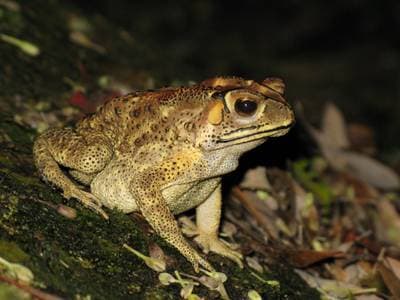
The Malayan horned frog (Megophrys nasuta) is one of Southeast Asia's most distinctive amphibians, instantly recognizable by its prominent horn-like projections above the eyes and on the tip of the snout. Its robust body is covered in brown, textured skin that mimics dead leaves with remarkable fidelity, making it almost invisible on the forest floor.
Pavel Kirillov from St.Petersburg, Russia (CC BY-SA 2.0)
Learn together
Use this page to talk about conservation, habitat, and why each species matters.
Quick facts
Perfect for kids and families
⚖️Weight
50–190 g
⏳Lifespan
5–12 yrs
🍽️Diet
Insectivore
🛡️Status
Least Concern
Mini challenge
What does Malayan Horned Frog usually eat?
Try together before you keep scrolling
Pick an answer
Weight
50–190 g
Length
7–13 cm
Lifespan
5–12 yrs
Diet
Insectivore
Listen to this species
Ljud
Distribution map
Utbredning
Adventure step • Meet the species
Overview
The Malayan horned frog (Megophrys nasuta) is one of Southeast Asia's most distinctive amphibians, instantly recognizable by its prominent horn-like projections above the eyes and on the tip of the snout. Its robust body is covered in brown, textured skin that mimics dead leaves with remarkable fidelity, making it almost invisible on the forest floor. Females can reach up to 13 cm in length and are substantially larger than males, a clear example of sexual dimorphism. This nocturnal ambush predator remains motionless for long periods, striking at insects, smaller frogs, lizards, and even small rodents that venture too close. Breeding is tied to the rainy season, during which males gather at clear, fast-flowing streams and produce loud, resonant calls to attract females. Eggs are deposited on rocks or vegetation just above the waterline, and tadpoles develop in stream pools.
Adventure step • Where it lives
Habitat
RainforestForestRiverMountain
This species inhabits primary tropical rainforests and moist montane forests up to approximately 1700 meters elevation, always in close proximity to clear, rocky, fast-flowing streams.
Adventure step • Through the seasons
Seasonal Behavior
During the rainy season, males congregate at streams to call and breed, while outside this period individuals lead solitary, cryptic lives among leaf litter. Activity peaks after dark when the frog emerges to hunt.
Adventure step • Family life
Breeding
Incubation
7 days
Offspring
40–200
Adventure step • Wild behavior
Behavior & Ecology
Activity Pattern
Nocturnal
Social Behavior
The Malayan horned frog is largely solitary except during the breeding season. Males can be territorial around calling sites along streams, competing vocally and sometimes physically with rivals.
Migration
Sedentary
Population
The species has no precise global population estimate but is considered relatively common across its range. It is listed as Least Concern (LC) by IUCN, though ongoing deforestation and habitat degradation pose increasing threats.
Did you know?
The horn-like nasal projection is one of nature's most convincing leaf mimicry adaptations, making the frog nearly indistinguishable from forest debris.
Tadpoles of Megophrys nasuta possess a unique funnel-shaped upward-facing mouth adapted for feeding on surface films and floating particles in streams.
Females are nearly twice the size of males, making this species one of the more dramatically sexually dimorphic frogs in Asia.
Despite its fearsome appearance, the Malayan horned frog relies almost entirely on camouflage and stillness rather than speed to both hunt and evade predators.
Adventure step • Scientific place
Taxonomy
KingdomAnimalia
ClassAmphibia
OrderAnura
FamilyMegophryidae
SpeciesMegophrys nasuta
No sources have been added yet.
Cite this page
Fun Wild Facts (2026) Malayan Horned Frog (Megophrys nasuta). https://www.funwildfacts.com/asien/amphibian/malayan-horned-frog [February 28, 2026]
Similar animals
Least Concern
🐸 Frogs
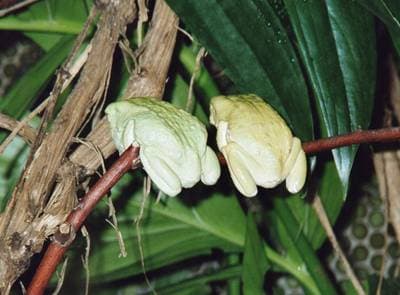
Reinwardt's Flying Frog
Rhacophorus reinwardtii
8–20 g
5–12 yrs
RainforestForestWetland
Least Concern
🐸 Amphibians
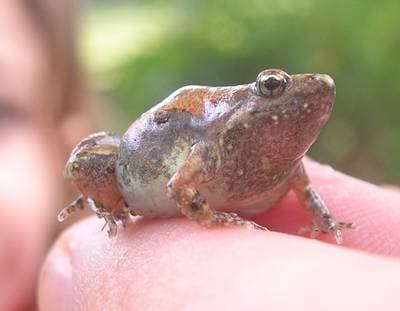
Ant Frog
Microhyla ornata
0.003–0.006 g
2–4 yrs
RainforestWetlandGrassland+3